Rio 2016 legacy plan completed as Olympic Aquatics Stadium pool opens for community use
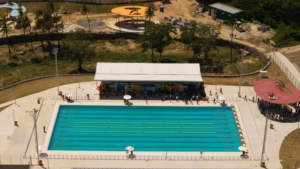
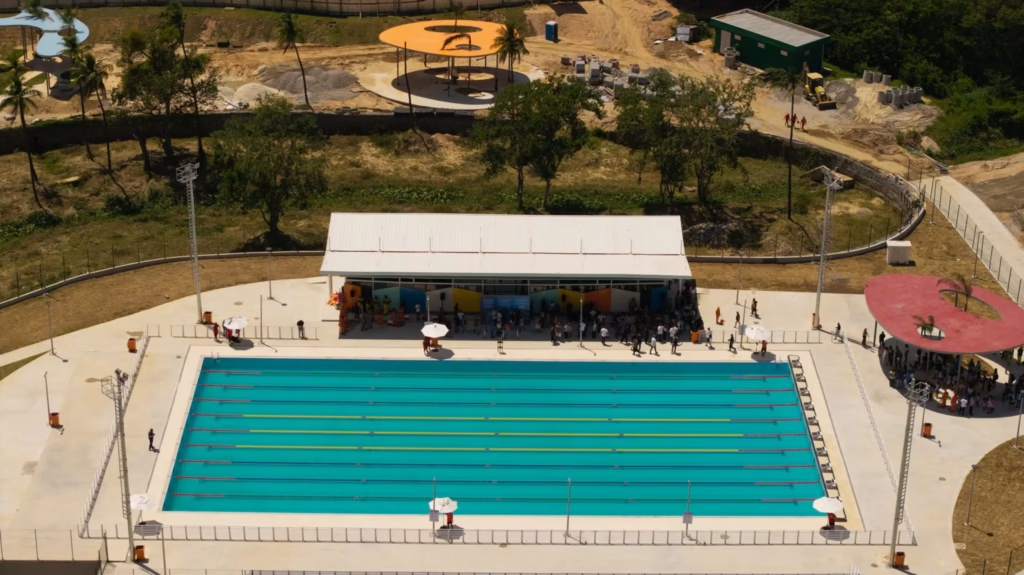
The main swimming pool from the Olympic Aquatics Stadium at Rio 2016 has reopened for community use in Rio’s West Zone, following its relocation to Parque Oeste Ana Gonzaga, a new local park in the area. Rio 2016 was designed to help accelerate Rio’s transformation through a community-focused legacy. In the years following the Games, governance challenges slowed aspects of delivery, and images of abandoned venues circulated online during that period. Legacy projects have continued to be implemented over the years, and this reopening completes the reuse plan for the Games’ temporary pools, bringing the Rio 2016 competition facility into public use.
Key facts
- The main Rio 2016 swimming pool reopened at Parque Oeste Ana Gonzaga on 28 December 2025, after being dismantled from the temporary Olympic Aquatics Stadium after the Games and reinstalled in the park. It now offers free swimming and hydrogymnastics classes for all ages, alongside weekend recreational sessions for families.
- With this reopening, the relocation and reuse of Rio 2016’s temporary swimming pools is now complete, following earlier repurposing in 2017, 2018 and 2019.
- While delivery took longer than planned following governance challenges after the Games, Rio 2016 legacy plans have continued to be implemented across the city — with the reopening of the main pool completing the final pool relocation.
Once the stage for unforgettable moments, including the farewell Olympic races of Michael Phelps and IOC President Kirsty Coventry, the main Rio 2016 swimming pool now serves local families, schools and clubs in Rio’s West Zone, home to some of the city’s most deprived neighbourhoods.
“Seeing the pool from my final Olympic Games now welcoming families and young local swimmers in Rio is incredibly special, said Coventry. “This is what Olympic legacy looks like: turning world-class venues into everyday places where people can be active and feel part of their community.”
The pool’s inauguration was attended by Rio Mayor Eduardo Paes, who highlighted the broader legacy of Rio 2016 across the city.
“This is the last Olympic legacy project that still remained to be delivered,” said Paes. “All the facilities — the X Park, the Rita Lee Park, the schools built in the West Zone — everything that was built for the Olympics was put to use afterward. This pool came from the Rio 2016 Aquatics Stadium. The structure of the stadium gave rise to many other things, and the pool had already been planned with the intention of being brought here to serve the population. And we want to develop athletes here. We are very proud to bring this Olympic legacy to the West Zone.”
Completing the Olympic Aquatics Stadium pool reuse plan
The Olympic Aquatics Stadium was designed from the outset as a temporary venue, intended to be dismantled and repurposed after the Games. While some images circulating over the years suggested the venue had been abandoned, its pool (and other temporary ones used across the Games) were always planned for relocation and reuse, while the infrastructure of the temporary building was intended to be dismantled. Delivery took longer than originally expected for some due to governance, economic and political challenges in the years after the Games. The pools have, however, now been repurposed in stages across Brazil:
- December 2017 – The first training pool is installed at an air force academy in the city of Guaratinguetá, near São Paulo.
- December 2018 – The second training pool is assembled in Salvador as a competition and community facility.
- July 2019 – The water polo warm-up pool is converted for use at a community centre in Manaus, in the Amazon region.
- December 2025 – The main competition pool is reopened at Parque Oeste Ana Gonzaga, in Rio’s West Zone.
Community first
The pool now installed at Parque Oeste forms the last remaining element of the Olympic Aquatics Stadium to be relocated, completing the legacy plan for a venue that was designed from the outset for post-Games community use.
Managed by the Municipal Sports Office, the pool offers free swimming lessons and hydrogymnastics classes for all ages, alongside weekend recreational sessions for families. Classes are structured by age group – from baby swimming to children, teenagers, adults and seniors – supporting inclusive access. At weekends, the pool becomes a leisure space with safety measures in place.
Demand has been strong, with the initial capacity of 700 places filled within hours and a waiting list already formed. The city is working to expand capacity so that more residents can benefit from the venue.
For Rio’s West Zone, the pool is more than a sports facility, it’s a symbol of inclusion and opportunity, providing space for physical activity, talent development and community life, It reflects the IOC’s broader approach to venues: ensuring that any new venue is designed with a clear post-Games purpose so it can continue to serve communities for years to come.
Part of a wider legacy
The pool’s reopening is part of a continued expansion of Parque Oeste Ana Gonzaga, which is adding amenities such as a viewpoint, an ecumenical space, cascading showers, changing rooms and dining areas. Future additions will include playgrounds, multi-sports courts, sand courts and two public schools, strengthening the park’s role as a hub for culture, sport and leisure.
This local development sits within a wider Rio 2016 legacy programme, with venues and Games-time spaces repurposed for public use through parks, education projects and sports facilities. While the implementation of the legacy plan was delayed due to governance challenges in the years after the Games, projects have continued to be delivered in stages.
- In Rio’s West Zone, the canoe slalom venue at Deodoro reopened to the public as a swimming pool in September 2016, just weeks after the Games ended. It continues to host high-performance training and competitions at national and international level.
- In the Olympic Park, legacy projects have continued in recent years. In 2024, Carioca Arena 3 was converted into a special sports education institution, while materials from the Arena of the Future – designed as part of the “nomadic architecture” concept introduced by the organisers for some of the facilities – have been reused to build four public schools in neighbourhoods in the West Zone.
- In the same area, Rita Lee Park was inaugurated in May 2024 in the Olympic Park, transforming a former Games-time pedestrian zone into a public space for sport and physical activity.
- The Rio BMX track reopened after a full renovation in January 2025, set to serve both the public and high-performance athletes. And at the heart of the Olympic Park, the Rio Olympic Museum opened in the velodrome in August 2025, offering an interactive journey through Rio 2016 and highlighting the Games’ legacy alongside the park’s wider community facilities.
- The Maracanã Stadium, which hosted the Opening and Closing Ceremonies and football at Rio 2016, was placed under the management of Flamengo and Fluminense, and hosts regular matches alongside occasional concerts. It welcomed more than three million football fans in 2025.
With the main Olympic swimming pool now reopened at Parque Oeste, the reuse plan for the Olympic Aquatics Stadium pools is complete, and another part of Rio 2016’s legacy is now fully in community use.
Source: Olympic